2023-2024 Japanese-Language Program for Foreign-Service Officers and Public Officials
The 2023 - 2024 Japanese-Language Program for Foreign-Service Officers and Public Officials took place at The Japan Foundation Japanese Language Institute, Kansai, from September 27th, 2023 to May 24th, 2024.
In this edition of the program, we were 34 participants; 28 diplomats and 6 public officials, from the following countries: Azerbaijan, Bangladesh, Burkina Faso, Cambodia, Colombia, Dominican Republic, Egypt, Gabon, Ghana, Guatemala, Honduras, Indonesia, Iran, Kenya, Kyrgyztan, Lesotho, Libya, Malaysia, Maldives, Mexico, Moldova, Mongolia, Nicaragua, Pakistan, Palestine, Sao Tome and Principe, Somalia, Tajikistan, Tanzania, Timor-Leste, Togo, Türkiye, Uzbekistan and Vietnam.
The program, organized by the Ministry of Foreign Affairs of Japan and the Japan Foundation, provides Japanese-language ability on daily situations and also a basis to perform work tasks on said language both for those diplomats to be posted to Japan after the program and for the public officials who, at their countries, perform duties related to Japan. Additionally, the program offers a wide range of activities aimed at understanding the Japanese culture and building a robust network with Japanese institutions on different fields.
The program
In order to achieve the abovementioned, the program has 3 main components, that are briefly described below:
1.Japanese language lessons
The program provides intensive lessons for 5 days a week, with various assignments due the next day. These lessons focus on different skills: oral communication, learning grammar and writing. The main resources used are textbooks designed by the Japan Foundation but, in addition, numerous printed and digital tools are provided in order to support the learning process.
Thanks to the methodology and study tools, the program participants can reach a level at which they can communicate in simple and routine tasks requiring basic and direct exchange of information on familiar topics and activities, and handle short social exchanges.
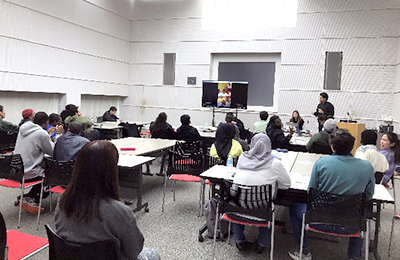
Japanese Language Presentation Class
2.Understanding Japanese culture and society
Mexican Nobel Laureate of Literature, Octavio Paz, who served as member of the Mexican Foreign Service during more than 20 years and was posted to Tokyo in 1951, described Japan as a very beautiful country and an admirable, courteous, happy people, for whom poetry, painting and life do not constitute worlds apart.
As a Mexican diplomat, I was eager to understand Japanese culture and society and to discover the beautiful country described by Paz. Thanks to this program, all the participants managed to achieve said goal due to numerous activities such as specific lessons on life and culture, a home visit to a local family, a visit to an elementary school, calligraphy, flower arrangement, tea ceremony, playing Japanese drums, practicing martial arts, and many others. Plus, our daily interactions with local people deeply contributed to genuinely discovering the Japanese mind.
These efforts were supported by the residents of Osaka, particularly the Tajiri International Club, the Izumisano Cross-Cultural Association and the Kishiwada English Open Cafe, whose members became our local guides and friends. They helped us greatly to improve our language proficiency as well as to learn from Japan while we shared information and traditions about our countries with them.
The program also included study trips to pre-determined places, and one self-study trip to a destination chosen by each participant. In the case of the determined places, we visited Tokyo twice, as well as Hiroshima, Kobe, Kyoto and Nara (these last two cities being former capitals of Japan). There we learnt about the history, economy, traditions and beliefs of the Japanese people in order to get a better understanting of the nation that it is nowadays and the process to led to the current outcome.
The self-study trip, almost at the end of the program, had the aim to let us practice by ourselves everything we learnt during the past months and it was a great opportunity to prove ourselves that we could manage every possible situation in a solo trip, at the time of exploring a place or places we had particular interest in. The places that the participants visited include Beppu, Fukuoka, Nagano, Nagasaki, Nagoya, Okinawa and Sekigahara; each one of them fascinating.
-
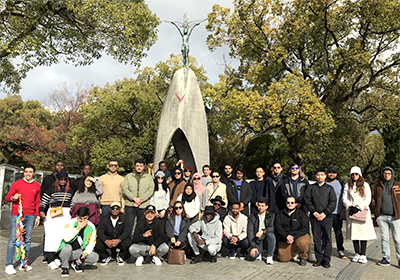
Peace Memorial Park, Hiroshima -
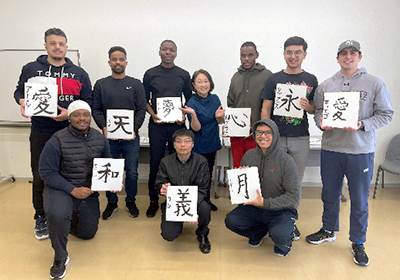
Japanese Calligraphy
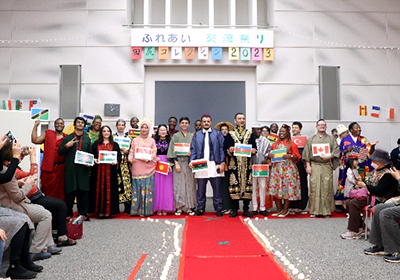
Fashon show event with local residents
3.Networking
The program included meetings with representatives of the Ministry of Foreign Affairs, the Ministry of Finance, the Japan International Cooperation Agency, the Japan External Trade Organization, and others. Each meeting was aimed to establish contact and create a bond among people in order to work together to achieve mutual interests. Moreover, the program allows and supports the participants to contact institutions they are interested in, to deepen their knowledge on Japan and increase the network of contacts they have.
-
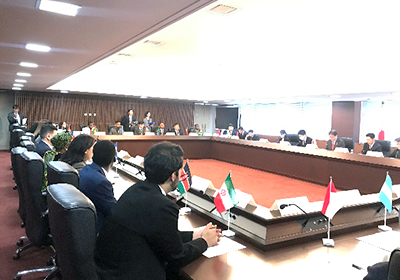
Courtesy call on State Minister for Foreign Affairs -
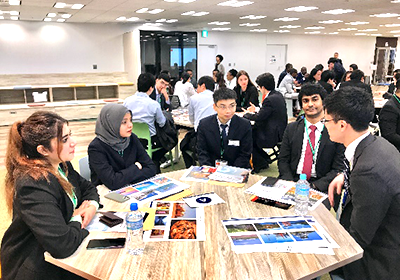
Meeting with JETRO members
Personal considerations
As a former participant of the program, I widely recommend to those interested in Japanese language and culture to apply for further editions. The program is complete, carefully designed and executed, and constitutes an unbeatable opportunity to get to know Japan first-hand in depth and in multiple facets. In my opinion, this program does not constitute an isolated activity, but rather the beginning of a professionalization path on topics related to one of the most relevant actors at a global level.
Additionally, it links diplomats and public officials from different countries, who will most likely coincide in the future and whose ties forged in Japan will be very useful for the relations between their countries.
On behalf of the 34 participants of the 2023-2024 Japanese-Language Program for Foreign-Service Officers and Public Officials, I would like to take this opportunity to express my recognition and gratitude to the organizers of the program and to all the staff of The Japan Foundation Japanese Language Institute, Kansai for making this an unforgettable experience. 皆さん、本当にありがとうございました!
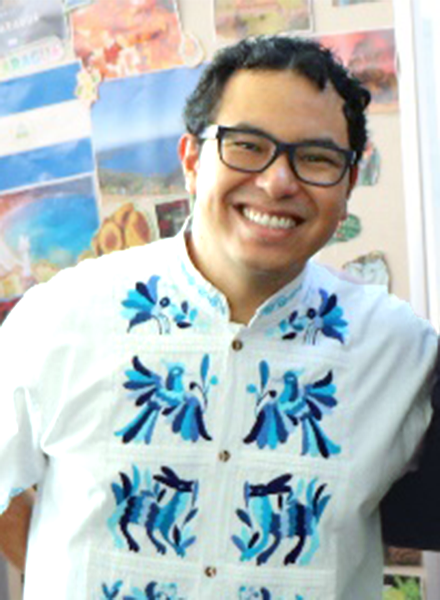
Mr. URIBE Miguel
Ministry of Foreign Affairs of the United Mexican States