





From August 2026, JFT-Basic Will Also Assess A1 and A2.1
The Japan Foundation Test for Basic Japanese (JFT-Basic) is conducted to measure the level of Japanese language proficiency necessary for communication in everyday life situations in Japan. Beginning in August 2026, the test will also assess A1 and A2.1 in addition to the current A2.
With this change, the test will be able to assess whether test takers have reached A1, A2.1, or A2.2 (A2) under the Common European Framework of Reference for Languages: Learning, Teaching, Assessment (CEFR), the JF Standard for Japanese-Language Education, and the Reference Framework for Japanese Language Education. As a result, in addition to its current use for the Specified Skilled Worker System (Specified Skilled Worker (i)), the test can also be used to assess the levels of Japanese language proficiency required for the Employment for Skill Development Program, which will begin in April 2027.
Japanese Language Proficiency Levels Assessed by JFT-Basic
| A1 | A2.1 | A2.2(A2) | |
|---|---|---|---|
| Until July 2026 | ― | ― | 〇 |
| From August 2026 | 〇 | 〇 | 〇 |
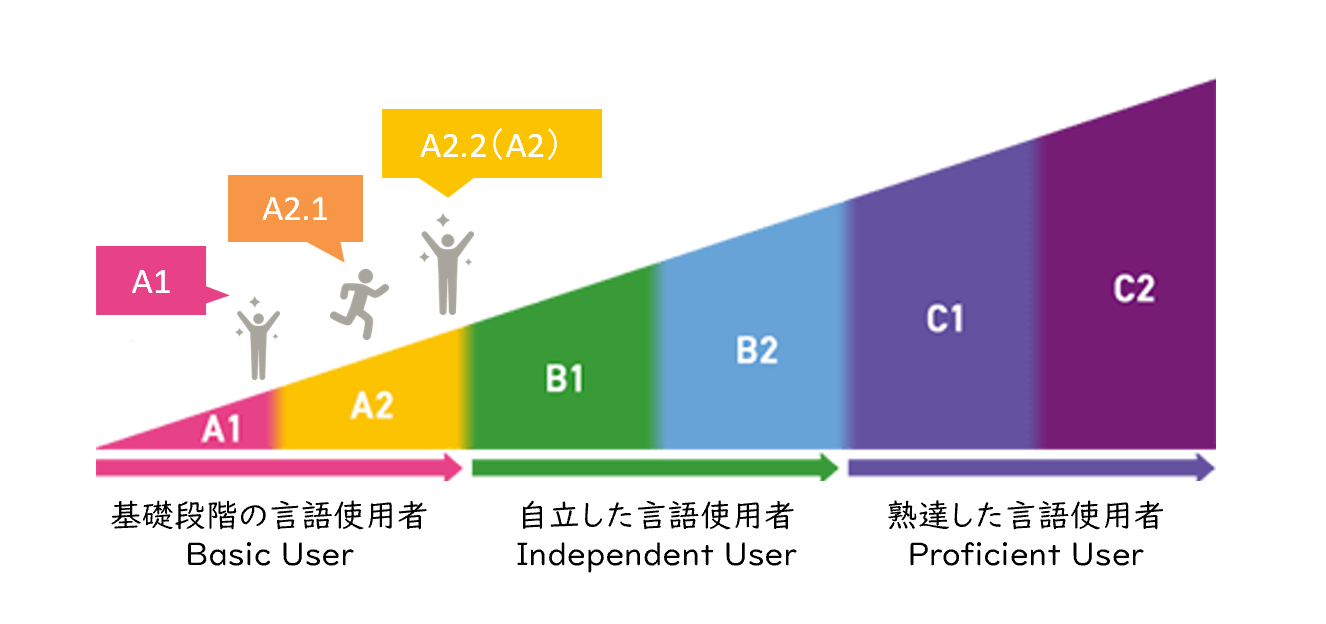
A2.2 (A2) corresponds to the A2 assessed until July 2026. A2.1 indicates that the test taker has reached A1 and is progressing toward A2.2 (A2).
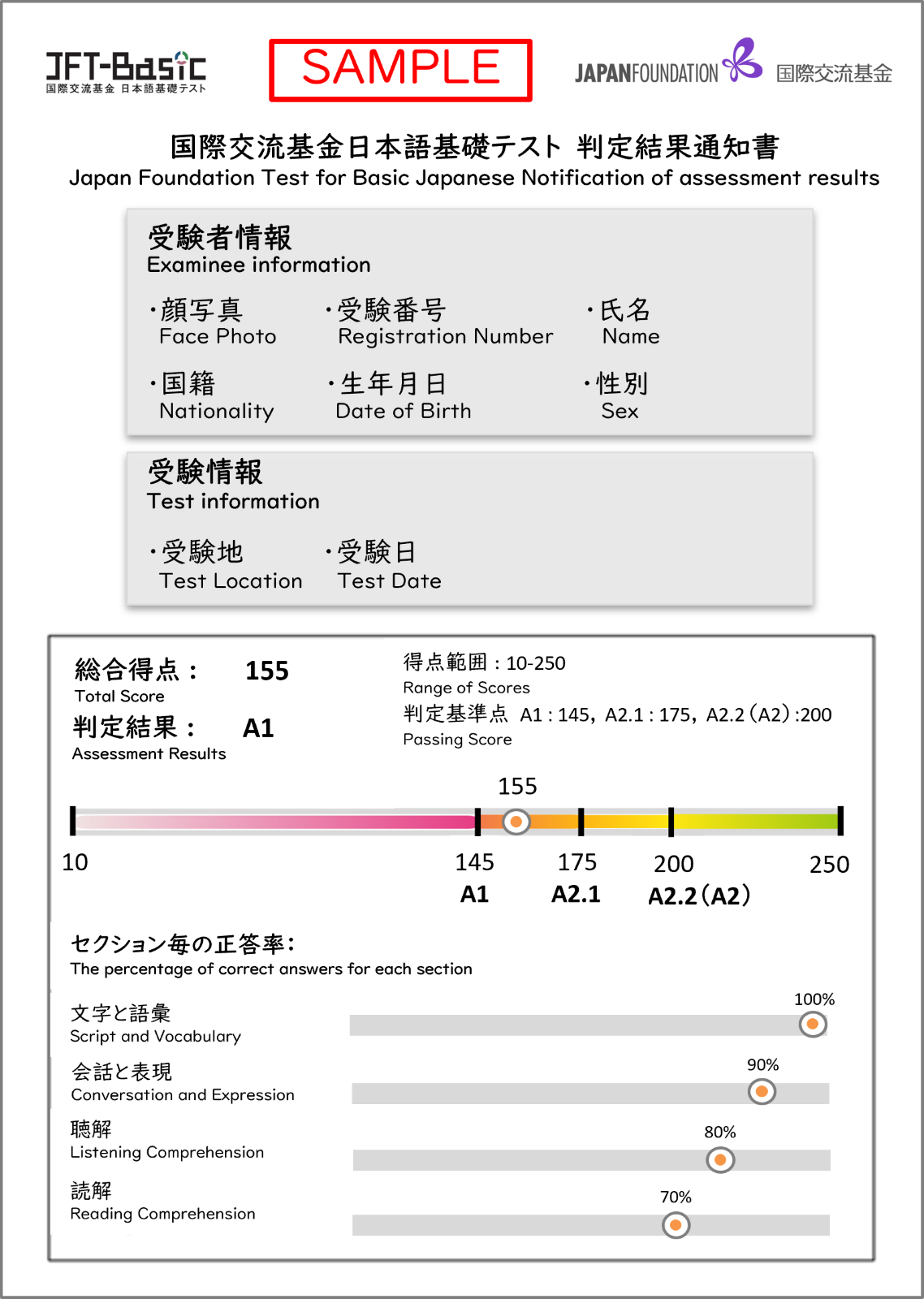
Sample Official Notification of Assessment Results
Within the range of scores from 10 to 250 points, scores of 145 to 174 are assessed as A1, 175 to 199 as A2.1, and 200 to 250 as A2.2 (A2). For scores below 145, assessment results will not be displayed and will appear as *.
Q&A
- Q: Will the testing method, test structure, or level of questions in the test change?
- A: No. For details on the testing method, test structure, and level of questions in the test, see the About the JFT-Basic page, sections 3. Testing Method, 4. Test Structure, and 5. Summary of Linguistic Competence and Levels.
- Q: Where can I use the A1 and A2.1 assessment results?
- A: Under the Employment for Skill Development Program, a Japanese language proficiency level equivalent to A1 or higher is generally required at the start of employment. The A1 assessment result can be used when applying to come to Japan for work under the "Employment for Skill Development" status of residence. A2.1 is a Japanese language proficiency level set between A1 and A2.2 (A2). The A2.1 assessment result is expected to be used mainly to confirm requirements for a voluntary change of employer under the Employment for Skill Development Program. Please note that, depending on the industrial field within the Employment for Skill Development Program, the Japanese language proficiency level required at the start of employment or at the time of a voluntary change of employer may be higher than the levels listed above (this is currently under review).
- For an overview of the Employment for Skill Development Program, please visit the Immigration Services Agency of Japan website
 .
.
- Q: Can official notification of assessment results issued up to July 2026 still be used from August 2026?
- A: Yes. If you take the test by July 2026 and your total score is the passing score (200 points) or higher, you can use the notification to prove that you have reached the Japanese language proficiency level of A2.2 (A2).
- If you need to prove that you have reached the Japanese language proficiency level of A1 or A2.1, to apply for the "Employment for Skill Development" status of residence or for other purposes, please take the test from August 2026 onward, when A1 and A2.1 assessments will be included in the official notification of assessment results.
- Q: What should I study to reach A1 or A2.1?
- A: The coursebook Irodori: Japanese for Life in Japan and the IRODORI Japanese Online Course are learning materials designed to help learners acquire the Japanese language proficiency needed for communication in everyday life situations in Japan, using Can-do learning objectives. The JFT-Basic also contains daily life questions based on Can-do. Therefore, studying with the Irodori: Japanese for Life in Japan and the IRODORI Japanese Online Course, and striving to achieve the Can-do objectives, will help you prepare for the JFT-Basic.
- In addition, the "Study content" of the IRODORI Japanese Online Course includes "Review quiz" covering Words, Kanji, Grammar, Expression, Listening, and Reading, which are similar to the sections and categories in the JFT-Basic. Its "Practice content" also allows you to practice Words, Kanji, Grammar, and Expression. Because the IRODORI Japanese Online Course offers highly practical practice activities, we encourage you to make use of it to help you prepare for the JFT-Basic.
- For more information, please see the Hint for Learning page, where you can find learning materials that will help you prepare for taking the JFT-Basic. Sample questions similar to the actual test format are also available, so you can get an idea of what the JFT-Basic will be like.