Message from the President
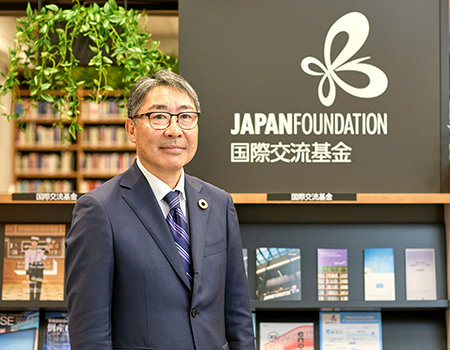
Thank you, as always, for your thoughtful engagement with the Japan Foundation and for your support of our work.
Last year, aided in part by the weaker yen, Japan welcomed a record-breaking number of overseas visitors, reaching 42.7 million. Notably, visitors’ interest in Japan is no longer limited to sightseeing. We’re witnessing a clear shift toward deeper engagement—particularly with Japanese culture. More and more people from around the world are not only appreciating the diversity of Japanese culture but also exploring its depths in conformity with their own interests and passions. It’s truly gratifying to see the growing allure of Japanese culture and how strongly it resonates with people across national borders. Meanwhile, fueled in part by the global popularity of manga and anime, the number of Japanese-language learners overseas has exceeded four million—a remarkable milestone. As an organization that has spent over half a century promoting Japanese culture and fostering friendships around the world, the Japan Foundation is honored to have played a part in these developments.
At the same time, persistent instability clearly exists throughout the global community—with the past year having seen deepening societal divisions, ongoing war in Ukraine with no clear resolution in sight, and continuing unrest in the Middle East. Elsewhere, attempts to alter the status quo using force have occurred. Most recently, tensions in Japan-China relations have come to the fore. In this increasingly uncertain world, Japan is being called upon to contribute more proactively to maintaining global stability and shaping a new international order. Against this backdrop, we are increasingly concerned about the tendency of many countries to emphasize hard power in their national-security discourse. In a world as complex and unpredictable as ours, we believe it is soft power—through cultural exchange, people-to-people engagement, and mutual understanding—that is more effective in achieving desirable and long-lasting outcomes. These forms of exchange play a vital role in preventing conflict and in building the foundations of sustainable peace and stability.
Cultural and people-to-people exchanges deepen mutual understanding, ease tensions, and lay the foundation for peaceful and stable international relations. Through these efforts, we will fulfill our commitment to fostering empathy and respect for different cultures—ensuring that Japan continues to be seen as a trusted and valued partner in the global community. With this in mind, we will further expand our efforts to promote Japanese culture abroad and support the growing interest in Japanese-language education. We will also promote cultural understanding through coordinated outreach, as we cultivate broad-based networks of cultural figures, academics, and youth. Through these multifaceted exchanges, we hope to contribute meaningfully to the realization of a more inclusive and harmonious multicultural society.
In particular, we will deepen our ties with ASEAN member countries through the medium- to long-term initiative “Partnership to Co-create a Future with the Next Generation: WA Project 2.0.” With participating nations and the broader ASEAN community, we will strengthen collaboration using a range of cultural initiatives. One example of these is our expansion of the Japan Foundation's NIHONGO Partners program, which assigns assistants to support Japanese-language classes and introduce Japanese culture in schools throughout Asia—especially in ASEAN countries. In addition, we are cultivating networks that link cultural figures and emerging leaders in Japan and ASEAN nations. By supporting co-creation and dialogue across the arts, academia, and other areas of human endeavor, we hope to create a vibrant space where cultural collaboration can truly exist.
With the United States—a longstanding and trusted partner—we will strengthen our networks of intellectual and grassroots exchange and help ensure that they are passed on to the next generation. We are also accelerating our engagement with countries in the Global South by expanding access to Japanese-language education, creating new opportunities for cultural exchange, and forging frameworks for international dialogue and partnership. Looking ahead, we remain committed to meeting emerging social needs. This includes advancing Japanese-language instruction in the context of Japan’s ever-evolving training and employment systems, developing improvements to Japanese-language testing, and actively leveraging the Japan Foundation’s network of NIHONGO Partners alumni—built over more than a decade—to promote a more inclusive, multicultural society. We will also continue to work closely with countries marking diplomatic milestones, reinforcing friendly relations through a variety of strategic initiatives.
As the Japan Foundation, we are truly thankful that Japan’s role within the international community has remained a peaceful one to this day. We remain committed to building trust between Japan and cultures around the world, even while navigating the complexities of an ever-changing global landscape. Looking to the future, we will continue working in partnership with institutions across the globe to foster valued, enduring, and forward-looking relationships.
We remain sincerely grateful for your continued partnership and steadfast support.
KUROSAWA “Billy” Shinya
President, The Japan Foundation
- About Us Top
- About the Japan Foundation
- Donations
- News & Topics
- News & Topics Top
- Main Activities
- Main Activities Top
- Fiscal Year 2026-2027
- Fiscal Year 2025-2026
- Fiscal Year 2024-2025
- Fiscal Year 2023-2024
- Fiscal Year 2022-2023
- Fiscal Year 2021-2022
- Fiscal Year 2020-2021
- Fiscal Year 2019-2020
- Fiscal Year 2018-2019
- Fiscal Year 2017-2018
- Fiscal Year 2016-2017
- Fiscal Year 2015-2016
- Fiscal Year 2014-2015
- Fiscal Year 2013-2014
- Events / Projects
- Press Release
- Press Release Top
- Fiscal Year 2026-2027
- Fiscal Year 2025-2026
- Fiscal Year 2024-2025
- Fiscal Year 2023-2024
- Fiscal Year 2022-2023
- Fiscal Year 2021-2022
- Fiscal Year 2020-2021
- Fiscal Year 2019-2020
- Fiscal Year 2018-2019
- Fiscal Year 2017-2018
- Fiscal Year 2016-2017
- Fiscal Year 2015-2016
- Fiscal Year 2014-2015
- Fiscal Year 2013-2014
- Links