
An Evening of Noh and Kyogen 2026
Every year in autumn, the Japan Foundation Kyoto Office organizes an event called “An Evening of Noh and Kyogen” to give people an opportunity to experience traditional Japanese culture, inviting international students, the Japan Foundation Fellows, and those enrolled at the Japanese-Language Institute, Kansai to join us.
Since its inception in 1974, this annual performance series has served as a cherished opportunity to experience the beauty of Noh and Kyogen. With the conclusion of the Kyoto Office's activities, the series will present its final performance this year. To mark this memorable occasion, a special program has been arranged, featuring Noh and Kyogen as well as performances of traditional Japanese music.
| Date and time | Tuesday, November 17, 2026 from 6:00 p.m. (Doors will open at 5:30 p.m.) |
|---|---|
| Venue | Kyoto Kanze Nohplay Theater (44 Enshoji-cho,Okazaki,Sakyo-ku,Kyoto) Tel: +81-(0)75-771-6114 ※Flyer:An Evening of Noh and Kyogen 2026 (PDF:6.4MB) |
| Program |
<Traditional Japanese Music> <Kyogen> <Noh> |
| Organizers | The Japan Foundation Kyoto Office |
| Collaboration | Katayama Noh and Kyomai Preservation Foundation, Kyoto Kanzekai, Shigeyama Kyogen Troupe, Art Research Center, Ritsumeikan University |
| Endorsement | Kyoto Prefecture,Kyoto City,Kyoto City Tourist Association, The Kyoto Shimbun Co., Ltd,Kyoto Arts and Culture Foundation |
| Admission Fees (all free seating) |
¥3,500 (students: ¥2,000) |
| Tickets will be Available from Tuesday, 15 September at |
Kyoto Kanze Nohplay Theater |
Programme Synopsis
Traditional Japanese Music:SHAKKO
This piece is a jiuta (traditional chamber music song) adaptation of a dance work from Kyoto-Osaka Kabuki that was based on the Noh play Shakkyo (“The Stone Bridge”). In the jiuta repertoire, it is classified as a sansagari-shibai utamono (theatrical song in the lowered tuning mode).
Although its immediate source remains uncertain, one theory suggests that the original version was Tsugai Jishi (“Paired Lions”), first performed at Kyoto’s Sōunza Theater in March 1738. This work is also believed to have served as the source for the Nagauta piece Hanabusa Shūjaku Jishi. If so, Shakkyo is considered one of the older compositions in the jiuta tradition.
The first half of the lyrics are written in a more colloquial and worldly style, while the latter half draws directly from the Noh play Shakkyo. It depicts the monk Jakushō, who, during his travels throughout the provinces, witnesses the appearance of a lion at the Stone Bridge leading to the Pure Land of Monju Bosatsu (Mañjuśrī Bodhisattva), and describes the mysterious lion dance that follows.
In addition, the instrumental interlude (tegoto) incorporates musical representations of the lion’s frenzied movements and the dramatic “hair-shaking” gestures that constitute the climactic highlights of lion dances in both Noh and Kabuki performance traditions.
Kyogen: SUO OTOSHI (The Dropped Gift)
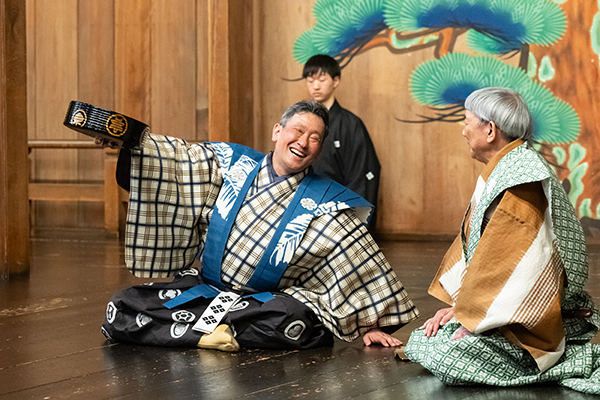
Kyogen SUO OTOSHI Photo by:Shuya Katsura
After suddenly deciding to make a pilgrimage to the Ise Jingu Shrine, the master sends his servant Tarokaja to invite his uncle to go along, as he has previously promised to accompany him. The master’s uncle declines the invitation, however, since it is so sudden. Figuring that Tarokaja will accompany the master in his stead, the master’s uncle offers Tarokaja some sake to see him off. As the sake takes its effect, Tarokaja begins to praise the uncle profusely, then ends up blurting out a string of complaints about his master.
Tarokaja finally sets out for home in high spirits, having received a suo, a traditional Japanese formal garment, as a gift from the master’s uncle. However, along the way, he runs into the master, who is worried because Tarokaja is so late in returning home. And then...
In the old days, a pilgrimage to the Ise Jingu Shrine was a momentous event comparable in significance to an overseas trip today. This performance offers many comedic elements: Tarokaja’s great delight at being able to take part in the pilgrimage, the way he becomes drunk at the urging of the master’s uncle, his bad-mouthing of his master, and the way he becomes flustered when he realizes that his suo robe is missing. All these moments are played for hearty laughs.<Kyogen>
Kyogen is a form of comic theater that emerged during Japan’s Muromachi period (around 1336 to 1573) and developed alongside Noh. It traces its origins to “Sarugaku,” a form of Japanese entertainment dating back to the late Heian period (mid-12th century). Later, the term “Nohgaku” was created to encompass these twin arts of Noh and Kyogen. While Noh is a tragic musical play, Kyogen is a comedy based on spoken dialog and wordplay. Performed as an interlude between acts of the more solemn Noh play, Kyogen creates comic relief, inducing laughter from the audience like a circus clown.
Stories of blunders in everyday life or making fun of the little quarrels among couples are the favorite motifs of Kyogen, a laughter theme unchanging even in modern days. Kyogen is a universal form of art that has made people laugh for centuries and will for centuries to come.
Noh: TENKO
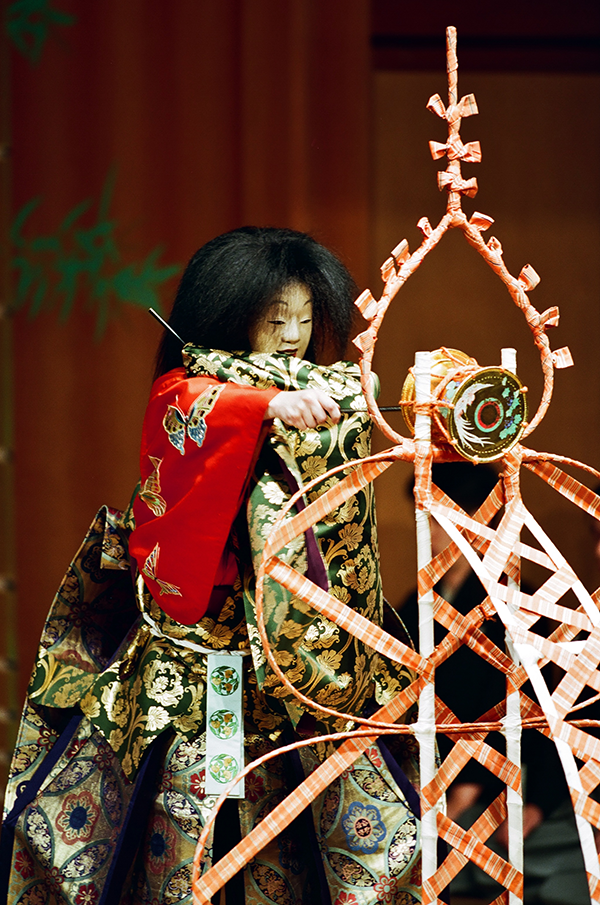
Noh TENKO
Photo by:Shinya Watanabe
In the Later Han Dynasty in China (25 – 220), there lived a man called Ohaku and his wife, Ohbo, who dreamed of a drum falling from the sky. She then gave birth to a baby boy whom the couple named Tenko, which means “heavenly drum.” Shortly thereafter, a drum actually fell from the sky. When Tenko played it, it gave off exquisite sounds. The Emperor learned about this and ordered that the drum be brought to him. Not wishing to part with his beloved instrument, Tenko fled to the mountains. He was at last caught and was weighed down to be drowned in the depths of the Rosui River, a waterway so horrid that it was said even fish could not survive in it. The drum was carried off to the palace, and, perhaps saddened by its separation from Tenko, would not give off any sound at all.
The Noh play begins at this point in the story. The Emperor orders that Tenko’s father be summoned, so one of his Retainers (waki [supporting role]) comes to the home of Ohaku (mae-shite [main role for the first half of the play]). While fearing for his life, Ohaku obeys the imperial command. Proceeding along the bridge passageway to the noh stage, Ohaku arrives at the palace where the Emperor lives. When the father plays the drum, the love between the father and his son causes the drum to resonate with exquisite tones, leaving the Emperor deeply moved. In accordance with the Emperor’s wishes, the Retainer has an attendant (aikyogen [role performed by a Kyogen actor]) take Ohaku back home and begins a memorial service for Tenko on the banks of the Rosui River. Tenko (nochi-shite [main role for the second half of the play]) appears, delighted by the ceremony. He once again plays his drum and dances to the music, only to disappear at the break of day.
<Noh>
Noh traces its origins as far back as the 14th century, and it has continued to this day, uninterrupted. Noh was originally a form of entertainment for the common people, as a rite performed to pray for bountiful harvests and good fortune. It later began to draw its plots from works of classical literature, giving the audience a greater appreciation for the literary depth of the world. Its themes include gods’ blessings, prayers for the dead, manifestation of beauty, and states of emotional unrest in the face of a crisis. These themes are universal, and hence Noh has continued to be appreciated.
The methods of expression in Noh have been refined over hundreds of years, and are distilled down to a bare minimum, evoking the audience’s imagination and inviting them to actively infer the significance of each move for themselves. Masks, costumes, music, and movements embody the essential features of Japanese culture. Join us, and we will guide you through the world of Noh to invite you to experience the essence of Japanese culture.
Profile
MIYOSHI Genzan
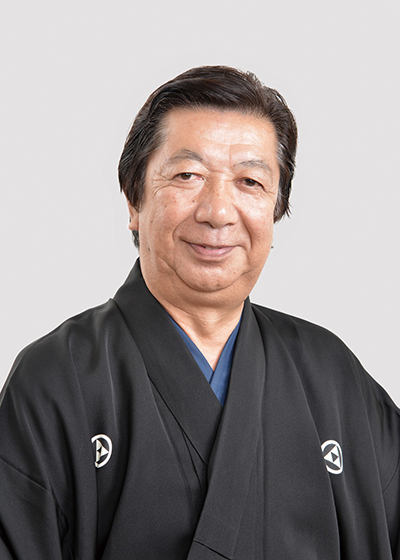
Born in Tanabe, Kyoto Prefecture, Miyoshi Genzan began studying the shakuhachi at the age of twelve under Tomii Shunzan of the Tozan School. He adopted the professional name Genzan in 1965 and was awarded the rank of Daishihan (Master Instructor) in 1971. In 1983, he received the prestigious title of Chikurin-ken, the highest distinction in the shakuhachi world.
Recognized as one of Japan’s leading shakuhachi performers, Miyoshi has appeared extensively throughout the world. Since 1980, he has served as a Cultural Envoy of the Japan Foundation, presenting concerts in the United States, China, Morocco, the Middle East, Poland, and many other countries. He has also been invited to perform internationally in Germany, France, Spain, the United States, Canada, Australia, and elsewhere, earning widespread acclaim from audiences worldwide.
In recent years, he has devoted himself to the preservation and promotion of the shakuhachi tradition through educational performances for young audiences and large-scale outdoor shakuhachi events. His awards include the Osaka Prefectural Cultural Festival (1980), the Kyoto City Cultural and Arts Association Award (1985), the Distinguished Service Award of the Kyoto Prefectural Culture Award (2012), the Ryukoku University Special Award (2021), and the Kyoto City Arts Promotion Award (2023).
SHIGEYAMA Sengoro
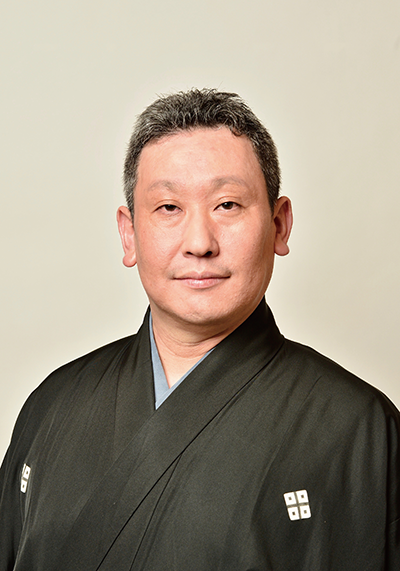
Born in 1972. Eldest son of Shigeyama Sensaku V. Birth name Masakuni.
First appeared on stage at the age of three as shite, the protagonist, of “Iroha.” Subsequently led several projects in his efforts to win new fans not just for Kyogen but also for Noh theater itself. Currently, he is working to communicate the appeal of Kyogen to a wider agerange of audiences by leading such projects as the Shigeyama Kyogen Kai, the Sengoro-no-Kai (Kyogen Productions by Shigeyama Sengoro), the “Cutting Edge KYOGEN” group, and the Waraenai Kai ( “the Unlaughable”) in partnership with Rakugo specialist Katsura Yonekichi. Sengoro has also actively collaborated with artists in other theatrical genres, including Chinese theater companies.
Succeeded to Shigeyama Sengoro XIV in 2016. Recipient of the Agency for Cultural Affairs’ New Artist Award of the National Arts Festival in 2005, recipient of Kyoto Prefectural Culture Award’s Encouragement Prize in 2008 and Distinguished Service Prize in 2025.
KATAYAMA Kurouemon
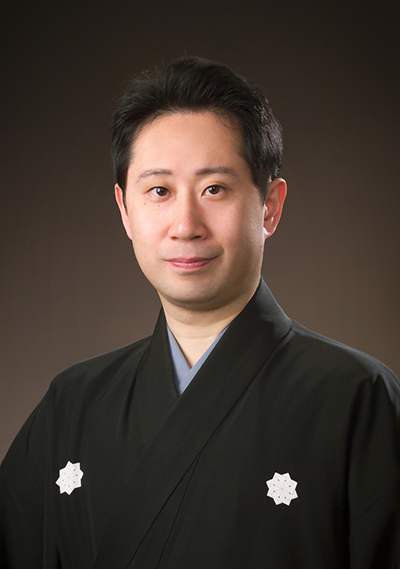
A shite (primary actor) of the Kanze School of Noh, Katayama Kurouemon was born in 1964 in Kyoto as the first son of Katayama Yusetsu (Katayama Kurouemon IX). His grandmother was the late Inoue Yachiyo IV, the former head of the Inoue School of the traditional Kyoto Kyomai dance, and his older sister is Inoue Yachiyo V, the head of the Inoue School.He studied Noh under his father and then Kanze Tetsunojo VIII. He organizes the Katayama Regular Noh performances. He performs frequently in theaters throughout the country, and often joins overseas tours as well.
He is involved in a variety of activities which are designed to share the joy of Noh with younger generations, including visiting Noh classes at schools, production of Noh picture books, and the creation of virtual Noh plays using computer graphics technology.
He is a Person of Cultural Merit of Kyoto City and a recipient of the Kyoto Prefectural Cultural Encouragement Award, the Kyoto Municipal New Artist Award, the New Artist Award of the National Arts Festival of the Agency for Cultural Affairs, the Japan Traditional Cultures Foundation Award, the Kyoto Prefectural Culture Award’s Distinguished Service Prize, the Minister of Education, Culture, Sports, Science and Technology’s Art Encouragement Prize for New Artists, and the Hisao Kanze Memorial Hosei University Nohgaku Award.
He is a holder of Important Intangible Cultural Properties (collective recognition) and also serves as director of the Kyoto Kanze Kai association and President of the Katayama Noh and Kyomai Preservation Foundation.
[Contact Us]
The Japan Foundation Kyoto Office
(3rd Floor, Kyoto International Community House 2-1 Torii-cho, Awataguchi, Sakyo-ku, Kyoto)
Tel: +81-(0)75-762-1136
- About Us Top
- About the Japan Foundation
- Donations
- News & Topics
- News & Topics Top
- Main Activities
- Main Activities Top
- Fiscal Year 2026-2027
- Fiscal Year 2025-2026
- Fiscal Year 2024-2025
- Fiscal Year 2023-2024
- Fiscal Year 2022-2023
- Fiscal Year 2021-2022
- Fiscal Year 2020-2021
- Fiscal Year 2019-2020
- Fiscal Year 2018-2019
- Fiscal Year 2017-2018
- Fiscal Year 2016-2017
- Fiscal Year 2015-2016
- Fiscal Year 2014-2015
- Fiscal Year 2013-2014
- Events / Projects
- Press Release
- Press Release Top
- Fiscal Year 2026-2027
- Fiscal Year 2025-2026
- Fiscal Year 2024-2025
- Fiscal Year 2023-2024
- Fiscal Year 2022-2023
- Fiscal Year 2021-2022
- Fiscal Year 2020-2021
- Fiscal Year 2019-2020
- Fiscal Year 2018-2019
- Fiscal Year 2017-2018
- Fiscal Year 2016-2017
- Fiscal Year 2015-2016
- Fiscal Year 2014-2015
- Fiscal Year 2013-2014
- Links