
YOMU: Literary Exchange and Dialogue—An Interview with Karina Robles Bahrin by Yoshida Kyoko
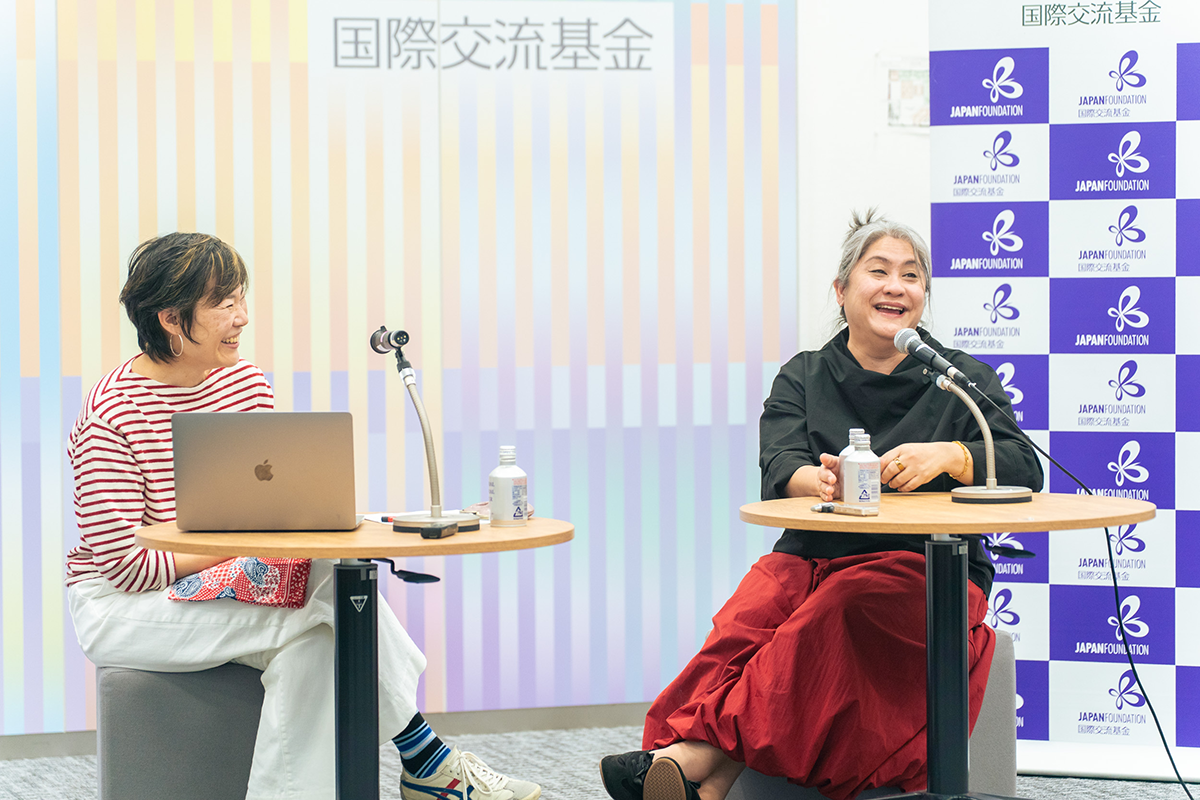
In the autumn of 2025, Malaysian writer Karina Robles Bahrin took part in the Kyoto Literary Residency. Her debut novel, The Accidental Malay, Winner of the 2022 Epigram Books Fiction Prize, opens with a startling premise: the heiress to a family business known for bak kwa (Chinese-style pork jerky) discovers that she is actually of partial Malay descent. The heroine’s wavering sense of identity mirrors the complexities of contemporary Malaysia, where lives are sensitively intertwined by state policies on religion and race. Yoshida Kyoko, a writer and translator, spoke with the author about the ideas and experiences that shaped this controversial yet intriguing work.
The Story Behind the Story
Yoshida: Karina, your debut novel, The Accidental Malay, may look like a classic “which guy will she marry?” story, but it actually weaves in sharp twists that reflect contemporary gender politics and social issues in Malaysia. The story follows Jasmine Leong, a businesswoman who inherits a Chinese pork jerky company, only to discover that she is of mixed Chinese and Malay heritage—making her a Muslim under Malaysian laws and customs. How did you come up with this plot? What was your initial inspiration or perspective?
Karina: The story has nothing to do with me, but everything to do with me. I wanted to explore the complexity of being a Malay in Malaysia, especially for people who don’t fit neatly into the definition. I’m of mixed heritage—my mother was born and raised Catholic in the Philippines before marrying my father—so I’ve never been a typical Malay. I often felt like I was standing slightly outside the community, and that experience made me want to write about these tensions.
It took me a very long time to finally write it. After thinking about it for about 10 years, I chose to tell my story through a Chinese woman who suddenly learns she is legally Malay and must confront the implications. Instead of writing about someone like me, who grew up in Malay and struggled with it all along, I wanted to approach the issue from an unexpected angle. So, I decided to push the envelope and asked myself, okay, what’s the worst-case scenario? The worst thing is someone discovering they’re Malay, and who would be the worst possible person for that to happen to? Someone who’s Chinese and about to inherit a very unhalal business.
Yoshida: It’s interesting because, while the definition of being Malay seems quite rigid, Malaysia appears to be such an ethnically diverse and multicultural society from an outsider’s perspective, like in Japan.
Karina: In Malaysia, a person can be Malay, Chinese, Indian, Eurasian, or others. We’re used to a highly diverse, multiethnic society. For example, it’s normal for Malaysians to have a Malay breakfast, an Indian lunch, and a Chinese dinner in a day. However, when it comes to being Malay, a clear, written definition exists in the constitution. To be considered Malay, one must speak Malay, follow Malay customs, and be Muslim. There’s no such thing as a non-Muslim Malay.
If a Malay person chooses not to be Muslim, they’d have to take the issue to court, but to my knowledge, no one has successfully done so. Most people, even if not strict in their practice, just go along with it because of the very high societal pressure and legal hurdles. The point is the absence of real choice—being Malay means being Muslim.
Yoshida: Your heroine Jasmine needs to choose between two men, Iskandar and Kuan Yew, one Malay and one Chinese. One thing, which doesn’t fully come across in the main narrative of the novel, is Iskandar’s inner conflict. He drinks, and his life isn’t exactly conventional.
Karina: Yes, but in urban spaces, it’s not uncommon to encounter someone like Iskandar, who is Malay and thinks, “This is the way I live. I’m not going to rock the boat, but I’ll try to do whatever I want anyway.” Of course, things have changed over the years. I can see that now, if I compare, for example, my father’s friends. From the time when I was a kid in the 1970s to now, fewer Malays drink, and they toe the line a lot more. Over time, people have become much more conservative. When I was younger, women were rarely seen wearing the hijab, but by the 1980s, it had become common.
Yoshida: I also witnessed that visual transition. It’s part of the global rise of Islamization, isn’t it?
Karina: Yes, Islamization was pushed in Malaysia in the 1980s.
Malaysian Society Reflected in the Work
Yoshida: How was the reaction to your novel in Malaysia?
Karina: People either love it or hate it! The reactions have been mixed. Those who want this kind of dialogue are supportive and call it brave. However, more conservative, right-wing Malays are upset, accusing me of attacking Malayness. My saving grace is that the book’s written in English. It’s less likely to stir controversy. The minute the book goes into Malay, I might end up needing an extended vacation somewhere else (laughs). Some people can be overly sensitive about these things.
Yoshida: Wow, that’s very gutsy of you, because once a book is out in the world, you can’t control what happens to it anymore. Did you want to provide a theme for discussion and conversation, but within certain boundaries?
Karina: Writing about a Chinese woman rather than a Malay gave me more flexibility. If I’d written it about a Malay woman, her choices would have been much more controversial. There’s still a bit of wiggle room, which might have been a reason I wrote the book the way I did. Yes, I intended people to think about the whole idea of the Malay definition, but this approach allowed me to sidestep certain things.
Yoshida: While your novel addresses national issues, it also feels like it doesn’t strictly belong to national literature. It’s part of this broader English literary tradition of novels about courtship, but also fits into the recent genre of stories about single women balancing careers and romance.
Karina: Yes, I’m very clear about it— I’m not a literary fiction writer. I’m not trying to be. For example, when I spoke to my publisher at Picador, I asked how they’d classify the book. She said, it is “upmarket” fiction, a generally commercial in plot but leans literary in prose. It straddles both, and that’s where I feel comfortable.
Yoshida: Your novel kind of reminded me of a Malaysian film, “Sepet,” directed by Yasmin Ahmad.
Karina: It may be similar in the sense that it tackles something serious but in a very commercial way. It’s an interracial story, and some undercurrents exist.
Yoshida: Are there many other interracial stories in Malaysia?
Karina: Not as many as there probably should be. But in real life, there are. Oh, you know, one of the cutest things that happened after I released The Accidental Malay is that readers come up to me and introduce their partners, saying, “This is my Iskandar.” You read my book, so you know what that means, right? (laughs) It’s either a girl with a Malay boyfriend or a Malay girl with a Chinese boyfriend. They’re so cute. And they always say “my Iskandar,” never “my Kuan Yew”!
I think these are the people this kind of story resonates with: either Malays who feel like they don’t fit in but can’t say it, or those who feel out of place because of religion, sexuality, or other reasons. So, it will find its readers, and then it will find its haters too, but that’s expected.
Career and Creative Journey
Yoshida: I also like that the heroine isn’t a young woman. She’s in her 40s, right?
Karina: Exactly. She’s about to inherit an empire. Hence, it makes more sense that she’s not 25.
I considered the heroine’s age, biologically speaking, describing that she might only get one more shot at motherhood, which adds a lot more drama. She’s running out of time, but she can also do things now that she can’t at 25.
Yoshida: It’s similar to your own story—publishing your first novel in your 50s. That’s also a Cinderella story for writers.
Karina: I first published short stories in my 30s, but they were part of anthologies. Then I quit my corporate job and moved to Langkawi about 14 years ago, thinking I’d finally start writing seriously. However, I stupidly thought I could do it while running a small business, which, of course, didn’t work. So, I didn’t write. I finally finished this novel during the COVID-19 pandemic. So, The Accidental Malay is a “COVID baby”! With the world slowing down, I decided to cross out what had been on my bucket list my entire life.
Yoshida: So, you’ve been writing since you were young, but you also had a corporate career. How did writing fit into that? Was writing what you always wanted to do from the start?
Karina: I’ve always wanted to write creatively. When I was younger, the internet was still new, and there weren’t many resources for creative writing in Malaysia. Only some small writing groups existed, but nothing compared to the opportunities young writers have today. The Malaysian publishing scene was limited, with few anthologies or opportunities. I only published two or three anthologies at a time, and when you are in your 20s or 30s, writing becomes less of a priority, especially when opportunities seem scarce. Thus, I focused on my career and didn’t do very much creative writing for a while.
Yoshida: You worked in corporate communications. Was that what you were interested in?
Karina: I originally wanted to become a journalist; however, I realized journalists don’t make much money. I don’t need to be rich, but I don’t like being poor (laughs). So, I switched to public relations, where you still get to write but aren’t poor.
Throughout my career, I have written speeches, annual reports, and press releases—just different kinds of writing. These experiences made me realize that I’m not precious about my creative writing. I mean, I’m used to being edited, so I work well with editors. Also, because I previously worked in the commercial industry, I understood the sales side of things. I’ve met some writers who might be a little bit idealistic, but for me, I understand the importance of the marketability of a product.
For example, when I first wrote my book, I initially thought of submitting it to Western agents, but I didn’t think it would gain attraction because Malaysia is small, and the story is very specific. My novel doesn’t fit into the Western gatekeeping stereotypes of what a Malaysian novel should be. I always tell people, if you want to get published by a big Western publisher, your novel needs one of these three things: the Japanese occupation, World War II, or ghosts! These three things will definitely get you in the door with a Western publisher, but I didn’t have any of that. My novel is contemporary.
So, I decided to give it a shot and set a deadline for myself. If I didn’t have an agent by then, I would submit to Epigram just to get it published and move on with my life. That’s the journey I took, a very pragmatic decision. However, I went in with a clear vision, knowing it was going to be a tough sell.
Yoshida: Another attraction of the novel is its very realistic and sometimes very ruthless depiction of business and politics. Did you get to achieve some revenge for your experiences in the corporate world?
Karina: Not really. I don’t have any hard feelings about my time in the corporate world. I was happy to leave, and it was my decision. I just packed up my dogs and moved to an island. It was 100% my choice, no one made me do it.
From a Measured Distance
Yoshida: What made you want to move to the island?
Karina: I was sick of Kuala Lumpur and didn’t like the politics. My last position was with the Stock Exchange, a government-linked entity. So, what’s the trajectory for someone like me from there? I figured Langkawi would be a good fit for a person coming from the city because it has an international airport, and the connectivity is great. As a tourist island, it’s not just locals—at least in Langkawi, I’m not that weird.
Yoshida: That reminds me of the Kyoto Writers Residency’s Opening Forum. The theme was “Embraced by Bears.” Bears were used as a metaphor for confrontation with others, the gap between people, and so on, especially since there had been so many bear attacks in Japan this year. I remember you comparing yourself to a bear. Could you elaborate on that?
Karina: I mean, I’m the outsider, the one who doesn’t quite belong. It goes back to my identity—being Malay but not fully fitting into Malayness. I’ve always felt like a bear in human clothing. I’m the bear in there.
I didn’t realize the existence of an issue when I was young, but as I got older, I understood that I wasn’t like the others. And that was okay, because my father wasn’t a conventional Malay either—he was a political activist in his 30s and was even detained as a political prisoner for a time. I didn’t grow up in a typical background. There’s a rebel streak in my family, and I see it as a badge of honor.
Langkawi is traditionally an agrarian society, comprising mostly fishermen and paddy farmers. Now, tourism is its main industry, and about two million tourists visit each year, but ethnically, it’s still a predominantly Malay community. Even though I’m Malay, because I’m not from the island, they don’t expect me to conform. They see me as someone from the city, which makes things easier.
Yoshida: I heard you work with young people there. Is that right?
Karina: Yes. After living in Langkawi for a couple of years, I noticed that young people had few opportunities for art exposure. So, I started a community initiative called Suatukala, which means “once upon a time,” like how a story begins. The goal is to encourage storytelling in young people and empower them to share their stories. We bring arts practitioners from Kuala Lumpur—in fields like theater, photography, spoken word, and visual arts—to hold workshops for local kids. Langkawi kids don’t have the same access to extracurricular activities as kids in Kuala Lumpur, so we try to fill that gap. We have also started a theater competition. Every year, the competition involves about 50–60 kids. Over the last three years, and considering both participants and audience, I’d say we’ve reached close to a total of a thousand people over the past 10 years.
The transformation you see in the kids, especially with theater, is dramatic—they change so much in a very short period. Every year, we get feedback from teachers and kids, and it’s always the shyest ones who really surprise us—with how much they’ve opened up. It’s amazing to see such huge transformations, making it so rewarding every year. Knowing how much power these experiences have, and how much they can bring to a child, makes it all the more meaningful.
Yoshida: Let’s talk about your own childhood. Did you grow up reading novels in English? What were your favorites?
Karina: When I was growing up, there wasn’t much literature available to me in other languages. At home, we spoke English as my mother is from the Philippines. She eventually learned Malay and spoke it fluently, but when I was a child, our household language was English. So, I grew up reading all the classics. Black Beauty, Heidi—Heidi was a big favorite for some reason. I loved it.
Yoshida: Oh, did you watch the Japanese animated version? It really shaped the psyche of Japanese women my age (laughs). Really, you must see it! It’s one of Takahata Isao and Miyazaki Hayao’s earliest works, so that’s another reason you should watch it.
Karina: A girl on a Swiss mountain shaped the psyche of Japanese women—that’s fascinating! I also read a lot of Enid Blyton and similar books. My parents were big readers, so as I got older, I would just borrow my dad’s books.

I used to write bad poems and short stories for fun. I enjoyed it as it was always something I wanted to do. I tell people that even at this age, I don’t see writing as a career, and I don’t think it ever will be. I consider it a vocation. I mean, I never want to depend on it to support myself. That way, I can be sure I write only for the love of it and only write what I truly want to write. Hopefully, I can keep doing it for the next 20 years. I like that it feels like my playtime. I can enjoy it even if my knees are bad 15 years from now, you know.
I’ve also reached a point where I really don’t care what the white publishing world considers worthwhile or not. I'm not going to write a story that will skew their audience because it will make it easier for me to sell it to them.
A New Story Begun in Kyoto
Yoshida: Tell me about your next novel.
Karina: When I applied for the Kyoto Writers Residency, I told myself, “If I get accepted, I’ll start my second novel.” And that’s exactly what I did when I came here. I’m now 10,000 words in, and I feel that’s enough to get me started.
The working title of my second novel is Bird, Water, Stone, which is inspired by the dynamics of rock, paper, and scissors. In the game, each element is both a victim and a perpetrator, and that’s the dynamic I want to explore with the three characters. The story revolves around a Malay woman artist, an older Japanese engineer, and an older Korean engineer. I wanted to write about Malaysia in the 1990s, a very different country back then. The financial crisis of the 1990s really shaped us, and I believe the Twin Towers would be a great motif. I’m from the generation that saw them built, and we benefited a lot from the economic boom of the time. The towers were built by Japan and Korea, and I wanted to reflect that connection in the novel.
Each tower was built by a different country, and they were competing with each other. The one that finished first would get a bonus because the Malaysian government needed them done as quickly as possible. Any delay beyond a certain point would cost the government $700,000 a day. The towers were completed in 1996 but officially opened in 1999. The Asian Financial Crisis hit right after Malaysia was declared to have the tallest buildings in the world. The timing was incredible—so much drama, and as a writer, why wouldn’t you want to explore that?
Yoshida: How do you handle writing about something semi-historical , especially with the benefit of hindsight?
Karina: Right. This novel is taking me longer to write because everything can’t be made up—there are certain timelines I need to consider. So, I keep stopping to check the accuracy of the information I wrote. Technically, it’s a historical novel. The 1990s are more than 25 years ago now, so it’s already a piece of history.
Yoshida: Yeah, it’s like writing about World War II in the late 1960s!
Karina: Exactly! We were a different country back then. I’m using these three characters from different countries as archetypes for their nations, reflecting how Japan, Korea, and Malaysia were shaped by their respective economic positions back then and how they’ve evolved.
Yoshida: How was your experience at the Kyoto Writers Residency with the other writers?
Karina: I feel very lucky because my cohort was incredibly nice, warm, and friendly. There wasn’t a single diva among the seven of us, which is surprising—writers can be like that sometimes. We didn’t interact all that much, but I didn’t mind because when we met, we discussed interesting topics, such as literature, books, and publishing. The conversation started the minute I arrived in Kyoto, which continued every day for a whole month.
I ended up spending most of my time with Francesco Ottonello, an Italian poet. I discovered that poets have a really different way of seeing the world. Things they say suddenly make you notice things differently—a tree becomes something else; the rocks seem fascinating. It was fun to interact with a writer so different from me and see the world through his perspective. And we saw some parts of Kyoto for the first time in our lives, which made it even more special.
Yoshida: Is there a plan to have The Accidental Malay translated into Japanese?
Karina: As far as I know, not in Japan yet, but the Korean translation has been sold. They have 18 months to publish it. Since the next book I’ve started writing features a Japanese character, hopefully, some Japanese translators will want to translate it.
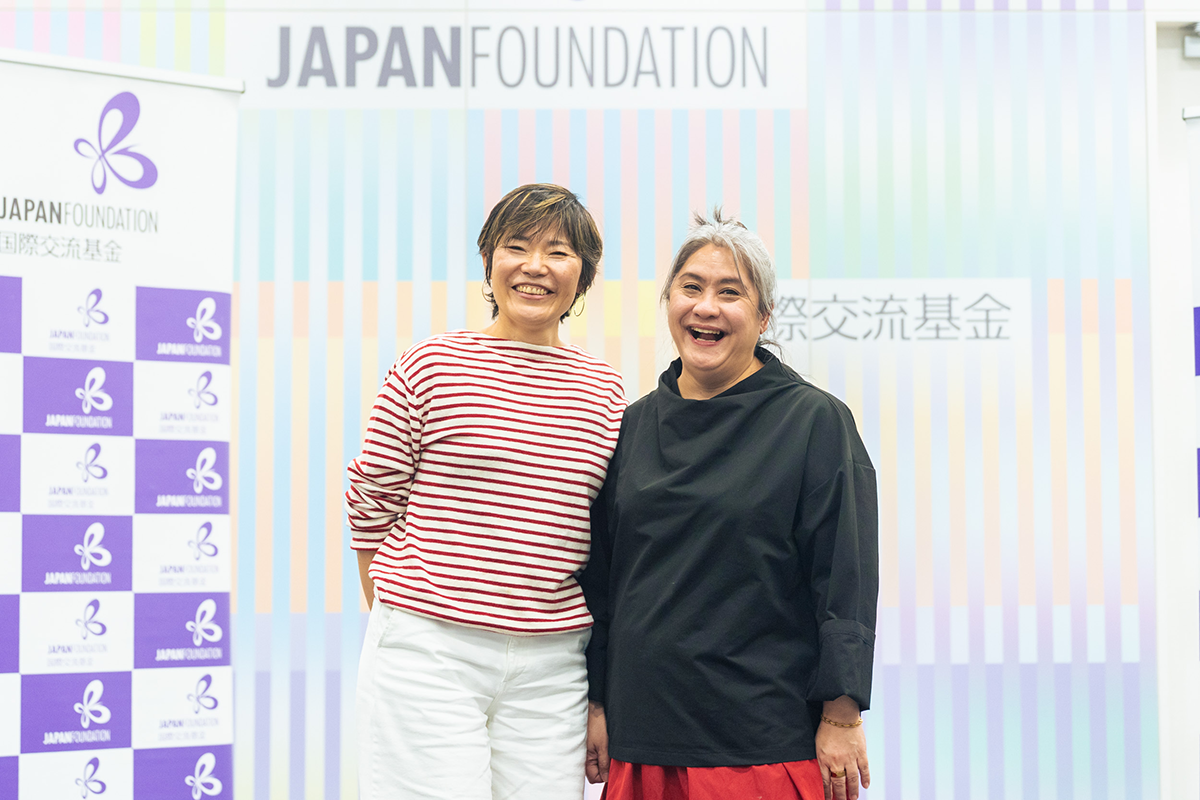
Photo: Sato Motoi
Profile

Karina Robles Bahrin is a Malaysian writer whose debut novel, The Accidental Malay (Epigram Books, 2022 & Picador, 2024), won the Epigram Books Fiction Prize 2022 and was a finalist of the Singapore Book Awards (Fiction). Her short fiction has been published in several Malaysian anthologies. She currently lives in Langkawi, Malaysia.
Yoshida Kyoko is a Professor at the Graduate School of Human and Environmental Studies, Kyoto University. She studied creative writing in the Department of English at the University of Wisconsin–Milwaukee and publishes fiction in English, primarily in U.S. literary journals. Her story collections include Disorientalism (Vagabond Press, 2013). She translates contemporary Japanese poetry into English and contemporary American fiction into Japanese.
She also serves as Director of the Kyoto Writers Residency.
- What We Do Top
- Arts and Cultural Exchange [Culture]
- Japanese-Language Education Overseas [Language]
- Japanese-Language Education Overseas [Language] Top
- Learn Japanese-language
- Teach Japanese-language
- Take Japanese-Language Test
- Know about Japanese-language education abroad
- The Japanese-Language Institute, Urawa
- The Japanese-Language Institute, Kansai
- Japanese-Language Programs for Foreign Specified Skilled Worker Candidates
- Japanese Language Education for Japanese Children Resident Overseas and for the Descendants of Migrants
- Archives
- Japanese Studies and Global Partnerships [Dialogue]
- JF digital collection
- Other Programs / Programs to Commemorate Exchange Year
- Awards and Prizes
- Publications