
CEFR level to be added for reference to JLPT score reports
- Nihongo Kyoiku News
- This corner introduces the latest information on matters of high interest to overseas Japanese-language educators from among the Japanese-Language Education Programs conducted by the Japan Foundation.
April, 2026
The Japan Foundation, Center for Japanese-Language Testing
1. Introduction of the Reference Indication of the CEFR Level for JLPT and its Background
The Japanese-Language Proficiency Test ("JLPT") is a test to measure and certify the Japanese-language proficiency of non-native speakers, administered by the Japan Foundation (JF) and the Japan Educational Exchanges and Services (JEES). It is the world's largest-scale Japanese language test, with approximately 1.72 million applicants in 96 countries and regions, including Japan, in 2024. The JLPT has five levels (N5, N4, N3, N2, and N1, with N1 being the highest level), and learners can choose the levels that suit their Japanese proficiency.
The Common European Framework of Reference for Languages: Learning, teaching, assessment (CEFR) (PDF: 1.2MB) was published by the Council of Europe in 2001 as the reference framework intended for common use in learning, teaching and assessment for language in Europe. In the CEFR, foreign language proficiency is divided into six levels (A1, A2, B1, B2, C1, and C2, with C2 being the highest level). The foreign language proficiency of a person at each level is indicated by the language illustrative descriptors (“can-do” statements, hereafter "illustrative descriptors").
The CEFR has been translated into as many as 40 languages and is widely used as an international framework able to show foreign language proficiency on a common basis across languages and borders. For the Japanese language, Japan's Agency for Cultural Affairs has released 「日本語教育の参照枠」(報告) (PDF: 6.7MB) ("Report: Reference Framework for Japanese-Language Education (available in Japanese only)) (“Reference Framework”), and JF has developed the JF Standard for Japanese-Language Education, as the frameworks for learning, teaching and assessment for the Japanese language, both based on the CEFR. The Reference Framework noted that as the content of Japanese-language learning and education continues to diversify, it has become necessary to develop and make available common indicators for Japanese language proficiency as assessed by various tests. In response to the Reference Framework, we decided to add the CEFR level as reference information to JLPT score reports, after carrying out various verification work so that JLPT test-takers and other JLPT stakeholders can apply the JLPT test results to the international framework (CEFR) and use the CEFR level as a reference. This will allow users to understand, for instance, which CEFR level corresponds to the Japanese language proficiency of JLPT N4 holders.
2. Reference Indication of the CEFR Level in JLPT
Starting with the December 2025 JLPT, the CEFR level is indicated as one type of reference information in the JLPT score reports (red frames in Figure 1). The CEFR level corresponding to the total score will be indicated for examinees who passed the test. For those who did not pass (including those with a total score that is higher than the overall pass mark but there is even one scoring section where the score is below the sectional pass mark), the CEFR level will not be shown, and a "*" will be shown instead.
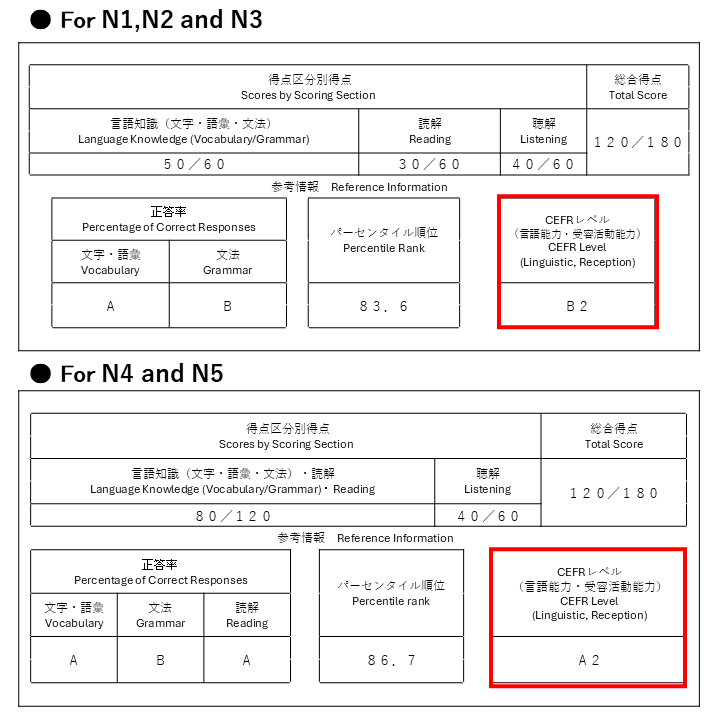
Figure 1: Example of Notification to Those Who Passed JLPT
Correspondence of the JLPT total score to the CEFR level is shown in Figure 2.
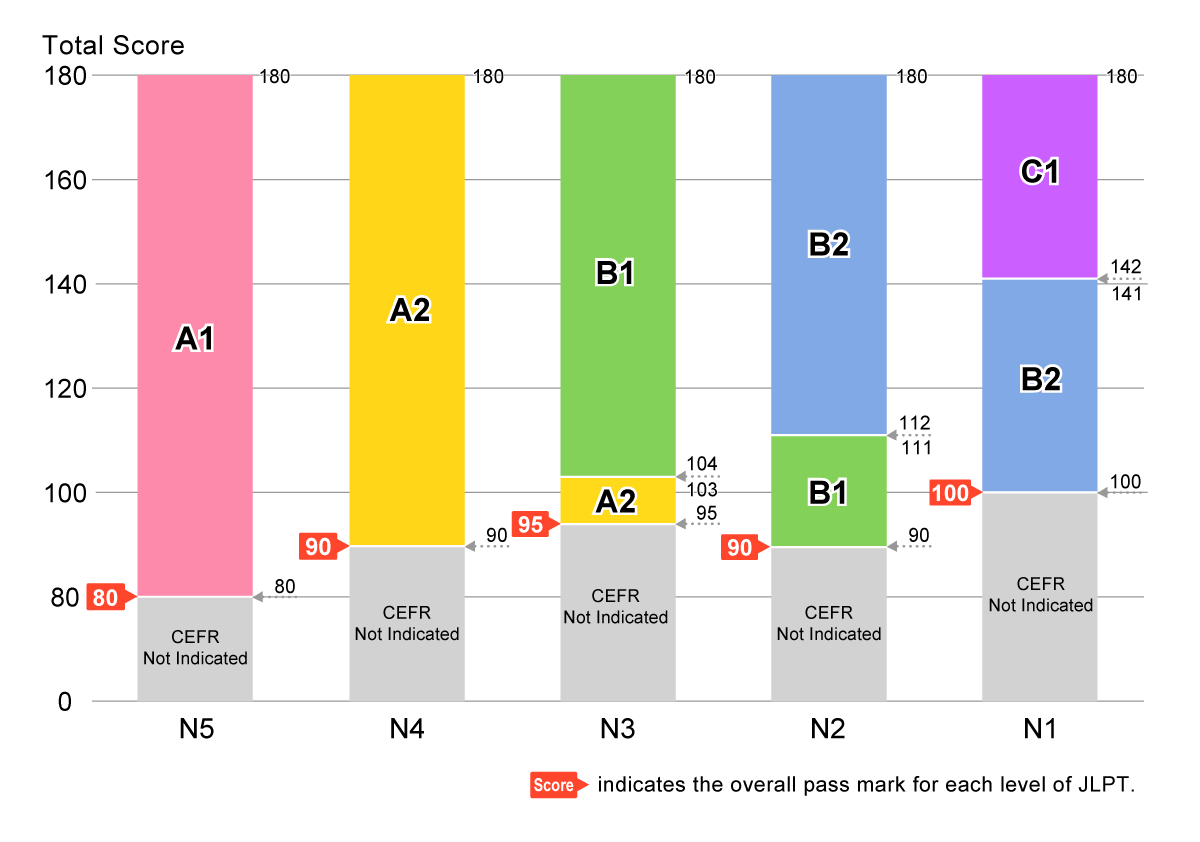
Figure 2: Correspondence of the JLPT Total Score (N5 to N1) Overall Score to the CEFR Level (A1 to C1)
The CEFR level corresponding to the total score of each JLPT level is indicated for reference. The total score for N5 and N4 is the sum of "Language Knowledge (Vocabulary/Grammar), "Reading" and "Listening", while the total score for N3, N2 and N1 is the sum of "Language Knowledge (Vocabulary/Grammar)," "Reading" and "Listening."
Specific reference indications are as follows:
- For N5, a total score of 80 or higher is indicated as A1 level.
- For N4, a total score of 90 or higher is indicated as A2 level.
- For N3, a total score of 95 to 103 is indicated as A2 level, and 104 or higher as B1 level.
- For N2, a total score of 90 to 111 is indicated as B1 level, and 112 or higher as B2 level.
- For N1, a total score of 100 to 141 is indicated as B2 level, and 142 or higher as C1 level.
For N3, N2 and N1, the reference indication of the CEFR level varies depending on the total score within each JLPT level. The height (range) of each CEFR level in Figure 2 indicates the JLPT score, not the volume of those who pass.
Note that the reference indication of the CEFR in JLPT corresponds to "Linguistic" and "Reception"(referring to listening and reading skills) in the CEFR. It does not include "Production" (referring to speaking and writing skills) or "Interaction." The "Language Knowledge," "Reading" and "Listening" tested by the JLPT correspond to the "Linguistic" and "Reception" in the CEFR (red frame in Figure 3).
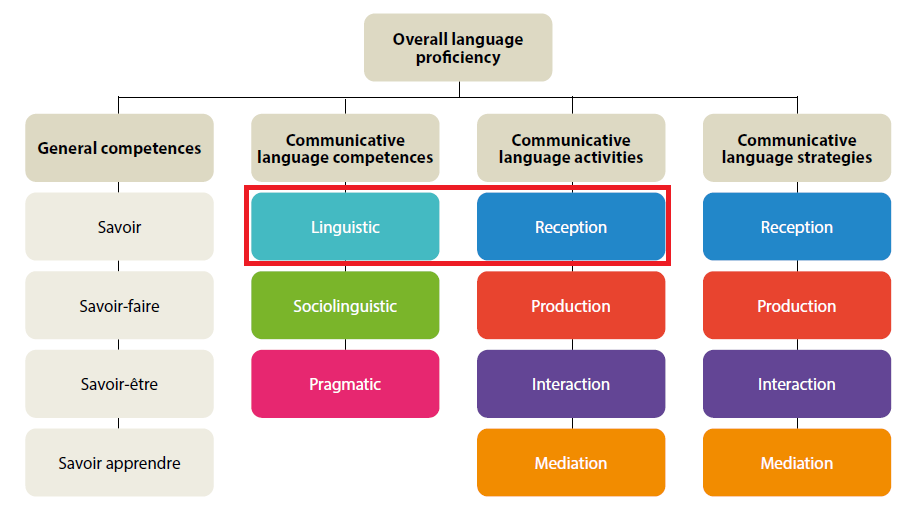
Figure 3: The Structure of the CEFR descriptive scheme
Source: Council of Europe (2020), Common European Framework of Reference for Languages: Learning, teaching, assessment - Companion Volume (PDF:10.7MB), (c) Council of Europe Publishing, Strasbourg, p. 32
3. Method for Linking the JLPT to the CEFR
The Council of Europe, which published the CEFR, released the manual in 2009 for language examinations that refer to the CEFR (Relating Language Examinations to the Common European Framework of Reference for Languages: Learning, Teaching, Assessment (CEFR). A Manual (PDF: 3.6MB) ). The "Reference Framework," released by Japan's Agency for Cultural Affairs also cites the manual, and the JLPT also has referenced the proper manual for linking the JLPT to the CEFR. In linking the JLPT to the CEFR, correspondence of the JLPT total score to the CEFR level has been clarified, as shown in Figure 2. In the case of JLPT N3, the total score between 95 and 103 corresponds to CEFR A2 level, while that of from 104 or higher corresponds to CEFR B1 level—setting this boundary is called "standard setting" for linking purposes.
In October 2024, the Japan Foundation’s Center for Japanese-Language Testing conducted a "standard setting session" for the JLPT “Reading” and “Listening” test questions. A panel of twelve experts both from Japan and abroad familiar with the CEFR, testing and assessment, and the stages of development of Japanese language learners’ abilities, participated in this session. The following is the processes of a standard setting session conducted drawing on the above-mentioned CEFR linking manual.
(1) Familiarisation with CEFR (Familiarisation)
In order to ensure that a panel of judges has the proper understanding of the CEFR levels and illustrative descriptors which are the basis for linking processes, they conducted their own comprehension check of the CEFR illustrative descriptors for each level as a pre-session task, and fully and collectively discussed their results.
(2) Self-analysis of relevant qualifications and examinations (Specification)
The testing organization (the Japan Foundation’s Center for Japanese-Language Testing) itself analyzed the specification of JLPT, which is the subject of linking, in terms of the CEFR and shared the results with the panelists.
(3) Standardisation training and benchmarking (Standardisation)
The panel of judges analyzed the JLPT test questions and confirms the relationship between the CEFR and the JLPT in detail.
(4) Establishment of boundaries on the CEFR level scale (Standard setting procedures)
The panel of judges set the CEFR level boundaries on the list of JLPT test questions arranged in order of difficulty from easy to difficult.
In addition to (1) through (4), two other processes were also added to this standard setting. One was a preliminary survey, in which Japanese-language education specialists at JF-affiliated organizations —who provide education based on the JF Standard for Japanese-Language education, which refers to the CEFR — were asked to judge JLPT test questions in terms of the CEFR levels. The results of this survey were also shared at the standard setting session.
The other was to devise ways to apply CEFR levels to the JLPT. For CEFR illustrative descriptors that are difficult to apply directly to largescale tests, the testing organization presented its analyses, and these were discussed with the panelists during the session.
Through these procedures, the CEFR standard setting for the JLPT “Reading” and “Listening” was carried out. For “Language Knowledge”, in contrast, the levels were estimated from the results in these reading and listening results. In this way, the correspondence between the JLPT total score and CEFR levels was established, as shown in Figure 2. Note that the CEFR levels corresponding to the JLPT ranged from A1 to C1.
Due to the nature of the examination, we are not able to go into further details for its certain aspects of its development, please refer to Indication of the CEFR Level for Reference on the JLPT website and its FAQ.
We hope that the reference indication of the CEFR level for JLPT will be useful in furthering Japanese language education around the world.
Reference:
「日本語能力試験のCEFRレベル参考表示に向けて―対応付けの手続きを中心に―」 (PDF:806KB) (For Reference Indication of the CEFR Level for the JLPT; on the Linking Procedures; available in Japanese only)
- What We Do Top
- Arts and Cultural Exchange [Culture]
- Japanese-Language Education Overseas [Language]
- Japanese-Language Education Overseas [Language] Top
- Learn Japanese-language
- Teach Japanese-language
- Take Japanese-Language Test
- Know about Japanese-language education abroad
- The Japanese-Language Institute, Urawa
- The Japanese-Language Institute, Kansai
- Japanese-Language Programs for Foreign Specified Skilled Worker Candidates
- Japanese Language Education for Japanese Children Resident Overseas and for the Descendants of Migrants
- Archives
- Japanese Studies and Global Partnerships [Dialogue]
- JF digital collection
- Other Programs / Programs to Commemorate Exchange Year
- Awards and Prizes
- Publications