
ASEAN次世代専門家グループ招へい(第2期:宗教間対話)Mohammad Hilmy Baihaqy Bin Haji Awang Yussof
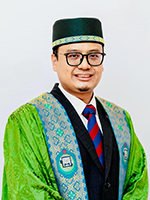
Mohammad Hilmy Baihaqy Bin Haji Awang Yussof(ブルネイ)
ブルネイ宗教大学 国際・広報センター 所長
訪日レポート
I was granted the privilege of participating in the Japan–ASEAN Interfaith Dialogue Program, which was organised by the Japan Foundation as part of the JFSEAP initiative. The theme of "Overcoming Social Division through Religion" was the focus of this program, which brought together scholars and practitioners from across ASEAN to engage in substantive dialogue with Japanese religious leaders, academics, and community leaders.
This program was not only an academic engagement for me, but also a profoundly reflective voyage. I was able to observe the operation of religion in a society such as Japan, where religious identity is frequently subtle but still has a significant impact on the formation of social cohesion and community life.
For me, one of the most significant lessons learned was that religion in Japan is frequently subtle yet influential. Through community projects and humanitarian endeavors, it actively promotes social well-being without controlling public speech. I was very pleased when I visited Masjid Otsuka and saw firsthand how a minority Muslim community can make a substantial contribution to Japanese culture. Their openness to collaborating with other faith organisations, particularly in disaster assistance and food distribution, was what most impressed me, in addition to their strong religious conviction. This, in my opinion, is a potent illustration of Islam as “Rahmatan lil 'alamin”—mercy to all—practiced in a minority setting.
The night outreach program to Ueno Station was another experience that profoundly affected me. I thought about the core of religion as compassion in action after taking part in the outreach activities which led by Chief Priest Gakugen Yoshimizu form Kosho-in Temple and seeing how Buddhist organisations help the homeless. Beyond theological arguments, I came to believe that religion's ultimate purpose is to help the weakest people of society.
The trip to the Tohoku area reinforced this contemplation even more. The idea of Rinsho Shukyoshi (interfaith chaplains) and learning about Café de Monk were really motivating. The way religious practitioners from all traditions unite to support, console, and listen to tragedy survivors without imposing their ideas profoundly touched me. This encounter got me thinking about how crucial humility, empathy, and presence are to religious engagement.
Based on what I've observed, religion in Japan functions in a peaceful and peaceful manner, frequently integrating into everyday activities and cultural customs. While the visit to Toyo Eiwa Jogakuin demonstrated how morals are ingrained in school without causing division, the visit to Meiji Jingu Shrine provided me a feeling of how spirituality is intertwined with nature and national identity.
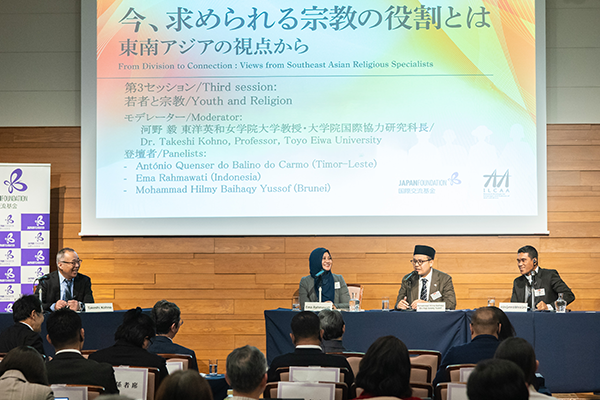
The Questions received from the audiences in the Public Panel Discussion was really engaging!
As I thought about this, I started to contrast it with the situation in Brunei Darussalam, where Islam is more prominent and plays a major part in both society and governance. I came to the conclusion that, despite Brunei's great social stability under the Malay Islamic Monarchy (MIB) system, we still have a lot to learn from the Japanese experience, especially when it comes to interfaith cooperation and community-based projects. For me, this program encouraged me to consider more thoroughly how religion may be communicated via deeds rather than words. I noticed that religious actors in Japan frequently emphasise common human values like compassion, care, and responsibility rather than ideological differences.
This has caused me to consider my own responsibilities as a member of the community and an academic. I started thinking, "Are we doing enough to convert religious teachings into real social impact?" Even after the program, I still find myself thinking about this question.
My academic philosophy and career goals have been greatly influenced by this encounter. As someone working in the field of Islamic civilization and contemporary issues, I see strong potential in incorporating these insights into my research. Firstly, I plan to integrate the Japanese experience into my work on civilizational dialogue and Brunei–Japan relations. The courses provided by Japan Foundation throughout this program has given me practical examples of how religion may serve as a cultural bridge, which is extremely pertinent to my areas of interest in study.
Secondly, in my teaching at Universiti Islam Sultan Sharif Ali (UNISSA), I intend to share these experiences with my students. Students will have a more open and fair perspective of religion, in my opinion, if they are exposed to real-world instances of interfaith cooperation.
Personally, this program has motivated me to consider community involvement outside the classroom. I am especially interested in investigating programs that use both Islamic principles and interfaith viewpoints to address issues that affect young people, like social isolation and the impact of digital culture.
Furthermore, I hope to strengthen academic and institutional collaborations with Japanese partners. Future collaborative research, discussions, and exchange initiatives will benefit greatly from the networks established in the course of this program.
Upon reflection, I can assert that this program has been both intellectually stimulating and personally transformational. It has enabled me to perceive religion from an alternative viewpoint—one that underscores humility, service, and coexistence. The most significant insight I gained is that religion need not serve as a catalyst for divide. When executed with sincerity and transparency, it can transform into a formidable catalyst for unification and societal harmony.
I am profoundly appreciative of the opportunity to engage in this program, and I anticipate utilising these insights in my scholarly endeavours, professional obligations, and community involvement. This event has prompted me to consistently contemplate how I may help to fostering a more compassionate and linked society.
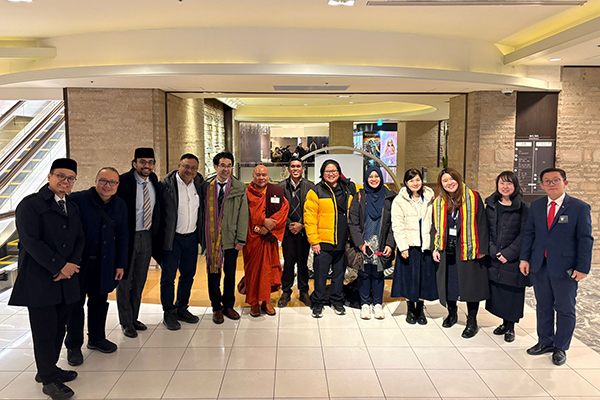
Participants with the officials from Japan Foundation during the final night of the program.
Everyone is hoping to meet each other again~
- 事業内容を知るトップ
- 文化芸術交流[文化]
- 日本語教育[言語]
- 日本研究・国際対話[対話]
- JF digital collection
- 特別事業/周年事業等
- 顕彰事業
- 刊行物のご案内