
“Irodori” Adds a New Pre-Intermediate (A2/B1) Level
- Nihongo Kyoiku News
- This corner introduces the latest information on matters of high interest to overseas Japanese-language educators from among the Japanese-Language Education Programs conducted by the Japan Foundation.
November, 2026
The Japan Foundation Japanese-Language Institute, Urawa
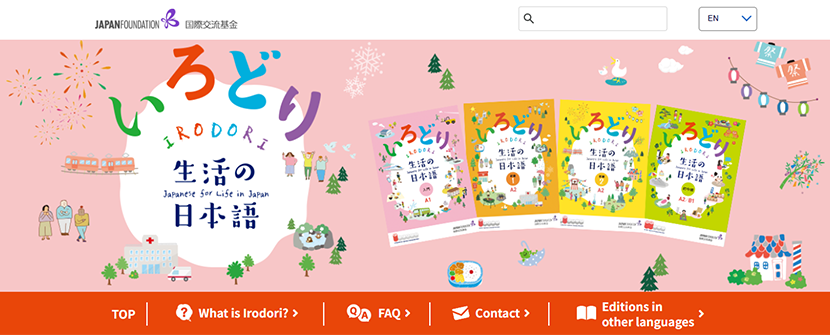
A new Pre-Intermediate (A2/B1) volume has been added to Irodori: Japanese for Life in Japan,1 a Japanese-language coursebook series for foreign residents in Japan.
Until now, Irodori consisted of three volumes: Starter (A1), Elementary 1 (A2), and Elementary 2 (A2). The series has been widely used in educational settings to help learners develop the basic Japanese communication skills needed for daily life in Japan. The newly released Pre-Intermediate (A2/B1) volume is for the next stage in the series. With this addition, the Irodori series now lets learners study Japanese for life in Japan from A1 all the way up to B1.
About the Irodori Series
Irodori: Japanese for Life in Japan was developed to help foreign people living in Japan gain the Japanese communication skills needed for daily life and work in Japan. The name “Irodori” means “adding color to your everyday life.” It reflects the hope that conversations and interactions with people around you will add color and richness to your life in Japan.
Irodori’s most notable feature is that it aims to increase what you can do using Japanese in real-life situations. It covers topics such as shopping, eating out, the workplace, relationships with neighbors, and hobbies, all of which relate to situations that foreign people living in Japan may actually experience. The learning objectives of each lesson are given as “Can-do” statements, so that learners can study with a clear understanding of what they will be able to do in daily life after completing the lesson. This Can-do-based structure is based on the JF Standard for Japanese-Language Education,2 which was developed with reference to the Common European Framework of Reference for Languages (CEFR).3 It also shares this approach with the Framework of Reference for Japanese Language Education4 issued by Japan’s Ministry of Education, Culture, Sports, Science and Technology (MEXT).
Irodori is not published in print but is available online free of charge. The PDF materials, audio, and other resources may be freely downloaded and used, and may also be freely copied, distributed, and shared, so Irodori is widely used in a variety of educational settings, including educational institutions around the world, Japanese-language classes in Japan, and online lessons across countries.5
Newly Released Pre-Intermediate Volume

Pre-Intermediate cover
The newly released Pre-Intermediate (A2/B1) volume is designed for learners who have already reached A2 level but want to further develop their Japanese ability. Its aim is to reinforce learners’ A2-level communication skills while also building more advanced B1-level communication skills.
In the CEFR, B1 is considered the threshold for becoming an “independent user.” At this level, learners are expected to be able to talk about familiar topics in a coherent way, explain their experiences and opinions, and deal with many situations that arise while traveling, for example. In other words, the Pre-Intermediate volume is designed to help learners progress from “being able to interact in a basic, simple way” to “being able to do most things on their own in Japanese in everyday situations.”
As with the previous volumes of Irodori, all materials are available online free of charge. The PDF consists of 635 pages, and there are 3 hours and 40 minutes of audio files in total. All can be downloaded free of charge. Only the main book has been released so far, but supplementary materials such as word lists and grammar worksheets, as well as editions in other languages, are scheduled for release in the future.
Features of the Pre-Intermediate Activities
The Pre-Intermediate volume also incorporates elements not found in the previous volumes of Irodori. The A2-level activities are at the same level as those in Elementary 1 and Elementary 2, but the texts are longer and closer to natural Japanese. The most notable aspect of the Pre-Intermediate volume, however, is the addition of B1-level activities.
At the B1 level, learners need more than the ability to handle simple questions and answers. They need to be able to organize information they hear and to express what they want to say coherently, while thinking about the structure. To achieve this, the B1 speaking activities incorporate “retelling” practice, in which learners take notes while listening to the audio and then use those notes to retell what they heard in their own words. After that, learners make notes on what they want to say while thinking about how to structure their talk, and finally give a coherent talk.


B1 speaking activities (click images to enlarge)
In the writing activities, there is a strong focus on written exchanges using messages and chat. These days, it is more common to communicate via smartphone messaging than by talking on the phone, and in daily life, written communication mainly consists of these kinds of exchanges rather than compositions. The activities reflect how people actually communicate in daily life.

Example of a written exchange (click image to enlarge)
In terms of language forms, one of the key features of the Pre-Intermediate volume is its detailed treatment of differences in style, including honorific expressions and the plain style. Up to and including Elementary 2, the goal for honorific expressions such as respectful and humble expressions, as well as the plain style used when talking with friends, was for learners to be able to understand them when they heard them. In the Pre-Intermediate volume, however, the goal is for learners to be able to use these forms themselves, so that they can communicate in a wider range of situations and at a deeper level. The activities therefore include practice in actually using them.

Grammar Notes: Respectful and humble expressions
Another notable feature is the explicit focus on strategies. At the B1 level, learners must deal with authentic Japanese even though their Japanese skills are still limited. For this reason, learners will also practice using strategies to complete tasks, such as using other words when they cannot remember the word they want to say, or guessing the meaning of unknown words from the surrounding context.

Strategy section
Japanese-Language Learning Materials for Daily Life through B1, Also Suitable for Community-Based Japanese-Language Classes
Irodori was originally developed to help foreign people prepare for life in Japan before coming to the country. However, because of its topics based on real-life situations, Can-do-based syllabus, and free availability, it has attracted attention as a resource that is well suited not only to overseas educational settings but also to settings inside Japan, such as community-based Japanese-language classes.
In recent years, community-based Japanese-language classes have increasingly been expected to design courses with a B1-level target in mind for learners. MEXT guidelines6 also position attainment of roughly the B1 level as one of the benchmarks for the language ability needed for independent living and social participation. In practice, however, many community-based Japanese-language classes struggle with how to design and structure B1-level courses.
Against this backdrop, the release of the Pre-Intermediate volume is highly significant. With the addition of the Pre-Intermediate volume to the previous three volumes (Starter, Elementary 1, and Elementary 2), Irodori now provides a continuous learning pathway, enabling learners to develop their Japanese ability step by step through 0 → A1 → A2 → B1. Studying all four volumes takes learners beyond the basic Japanese needed for daily life and helps them reach the B1 level needed for independent living in Japan. In terms of study time as well, the estimated time needed to study all four volumes of Irodori generally falls within the range that MEXT estimates for reaching B1 (a total of roughly 350 to 520 hours).
In this sense, Irodori can serve not merely as teaching material but also as a basis for designing courses for community-based Japanese-language classes. Building an entire course from scratch places a heavy burden on instructors, and designing for the B1 level in particular calls for a great deal of trial and error. Given this, a realistic and practical option may be to first use Irodori to shape the overall course and then adjust it to fit the needs and circumstances of each local area.
From Daily Life to Social Participation
The Pre-Intermediate volume shows many everyday scenes in which foreign residents take part in community activities or work alongside Japanese colleagues. It presents exchanges of many kinds, including chatting with one another, talking about hopes and experiences, seeking advice about concerns, and helping each other out when in trouble. Underlying this is the message that life in Japan should not be confined to just one’s home, workplace, and Japanese-language classroom, but should expand through connections with other people and society.


By expressing their own experiences and thoughts, understanding what others say, and building relationships with the people around them, learners take part in society as a “social agent.” The Pre-Intermediate volume seeks to build just such a capacity for self-expression and mutual interaction. This is linked to the central idea of the JF Standard for Japanese-Language Education that communication in Japanese can lead to mutual understanding among people.
Across the Irodori series as a whole, learning begins with Japanese for daily life and expands from there toward Japanese aimed at social participation. That, in turn, leads to mutual understanding among people. Irodori supports this kind of learning. It is hoped that Irodori, including the newly released Pre-Intermediate volume, will be used in a wide range of educational settings and will help deepen mutual understanding.
Notes:
- 1. Irodori: Japanese for Life in Japan website
- 2. JF Standard for Japanese-Language Education
- 3. Common European Framework of Reference for Languages (CEFR)
- 4. Ministry of Education, Culture, Sports, Science and Technology (MEXT): Framework of Reference for Japanese Language Education
- 5. Japanese-Language Education News: Free! New Teaching Materials “Irodori: Japanese for Life in Japan”
- 6. MEXT: Key Points of the Report “On the State of Japanese-Language Education in the Community” [PDF: 310KB] (available in Japanese only)
(ISOMURA Kazuhiro / Japanese Language Education Specialist, Japanese Language Institute, Urawa)
- What We Do Top
- Arts and Cultural Exchange [Culture]
- Japanese-Language Education Overseas [Language]
- Japanese-Language Education Overseas [Language] Top
- Learn Japanese-language
- Teach Japanese-language
- Take Japanese-Language Test
- Know about Japanese-language education abroad
- The Japanese-Language Institute, Urawa
- The Japanese-Language Institute, Kansai
- Japanese-Language Programs for Foreign Specified Skilled Worker Candidates
- Japanese Language Education for Japanese Children Resident Overseas and for the Descendants of Migrants
- Archives
- Japanese Studies and Global Partnerships [Dialogue]
- JF digital collection
- Other Programs / Programs to Commemorate Exchange Year
- Awards and Prizes
- Publications